
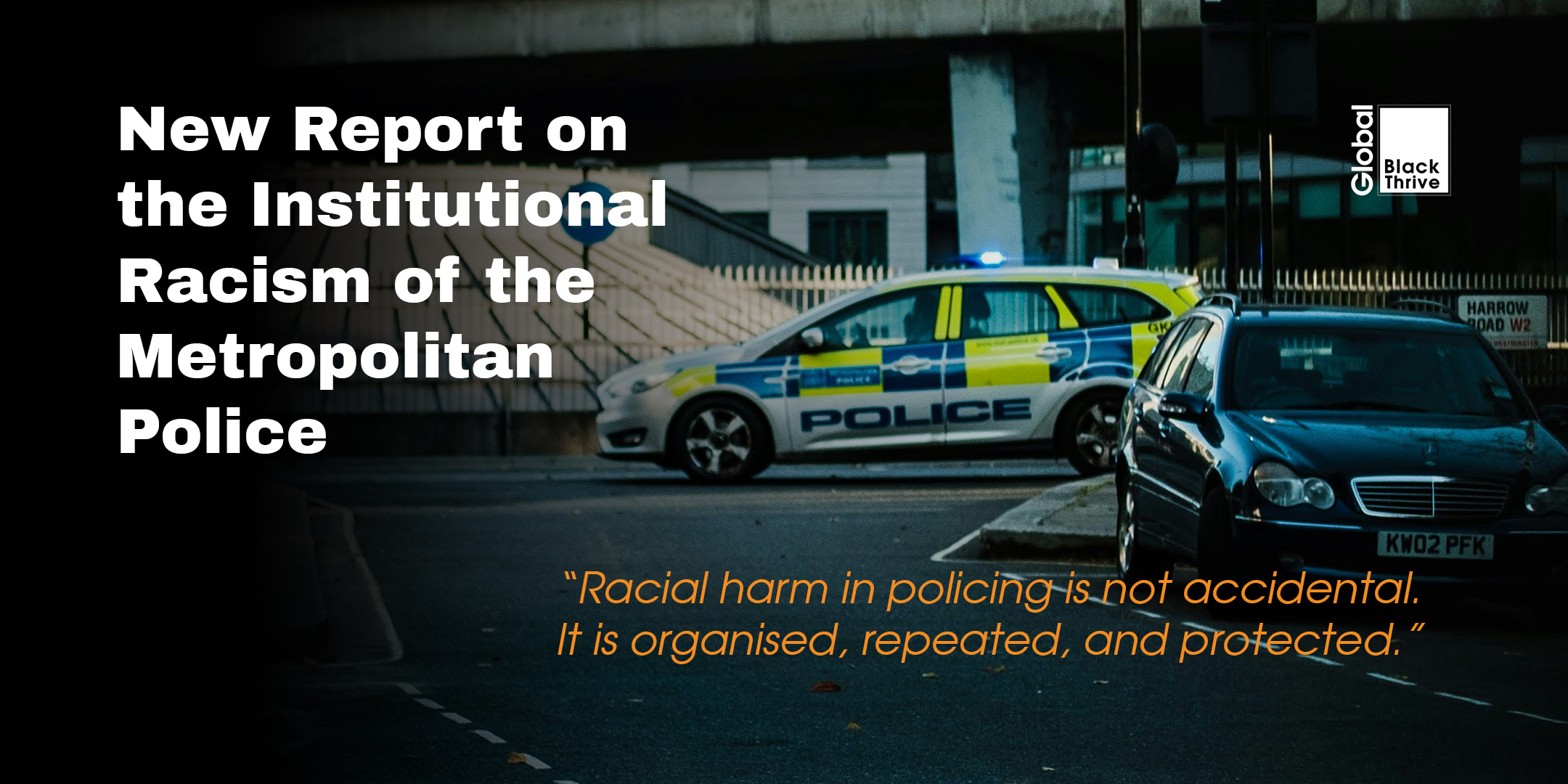
30 Patterns of Harm: New Report on the Institutional Racism of the Metropolitan Police

Why This Report Matters
The 30 Patterns of Harm report by Dr Shereen Daniels provides a clear and uncompromising examination of the structural racism embedded within the Metropolitan Police. Rather than framing racism as the result of individual misconduct or isolated failures, the report exposes how harm is produced, sustained, and normalised through institutional systems.
The report documents deep mistrust between Black communities and the police and details how this mistrust is shaped by over-policing, under-protection, weak accountability, and chronic under-representation. The report calls for structural reform rooted in transparency, accountability, and community-led scrutiny.
Crucially, 30 Patterns of Harm demonstrates that racial harm is not accidental. It is organised, repeated, and protected through institutional practices of denial, deflection, and self-preservation. Together, these patterns erode public trust and allow harm to continue without meaningful consequence.
Racism Embedded in Policy, Practice, and Evidence Frameworks
The report shows how racism within the Metropolitan Police is embedded in everyday policing policies and procedures, including stop and search, risk assessment tools, and intelligence-led policing. These systems are built on racialised assumptions that position Whiteness as the benchmark for credibility, safety, and evidence.
As a result, Black people are more likely to be framed as suspicious or disorderly. This leads to disproportionate surveillance, criminalisation, and use of force. Although these frameworks are presented as data-driven and objective, the report reveals how they conceal the racialised assumptions and logics that reproduce harm while appearing neutral.
An Internal Culture That Normalises Harm
Beyond policy, the report exposes an internal culture within the Metropolitan Police that allows harmful practices to persist. Racist language and so-called banter are minimised or dismissed, while discriminatory encounters are routinely normalised.
A culture of loyalty prioritises protecting colleagues over ethical conduct. Officers who speak out face resistance, marginalisation, or career repercussions. This environment discourages accountability and enables patterns of harm to become routine and institutionally sanctioned.
The Institutional Logic of Over-Policing Black Communities
The approach to policing Black communities is underpinned by stereotypes that frame Blackness as inherently risky and in need of control. These narratives shape decision-making across the institution, including resource allocation, deployment strategies, and how areas are identified as crime hotspots.
The result is sustained over-policing, disproportionate stop and search, and excessive use of force. As 30 Patterns of Harm makes clear, these outcomes are not mistakes or anomalies. They are the predictable result of decision-making processes shaped by racialised institutional logic.
Leadership Failures, Weak Accountability, and Institutional Self-Preservation
The report highlights systemic failures in leadership and accountability. Senior figures within the Metropolitan Police frequently describe racist incidents as isolated or unintentional, deflecting attention away from structural causes.
This language protects the institution’s reputation while shielding those in power from responsibility. Complaints are filtered, oversight lacks independence and transparency, and data is selectively interpreted to signal compliance rather than confront harm. As a result, officers who cause harm often remain unchallenged while public trust continues to deteriorate.
The Impact of Structural Harm on Black Communities
Erosion of Trust, Safety, and Belonging
Structural racism in policing fundamentally undermines trust. For many Black people, police encounters are experienced not as protection but as risk. Over time, this creates a reality in which safety feels conditional and shaped by race rather than rights.
Community-Wide Trauma and Health Consequences
The report documents the psychological and emotional toll of racialised policing, including fear, anxiety, hypervigilance, and generational trauma. These harms extend beyond individuals to families, neighbourhoods, and future generations.
Racialised policing is also a public health issue. Chronic exposure to surveillance and discrimination increases the risk of stress-related conditions such as depression, hypertension, and sleep disturbance. These factors contribute to long-standing health inequalities experienced by Black communities.
Social and Economic Consequences
Over-policing disrupts life chances. Its links to unemployment, school exclusion, housing insecurity, and poverty remain largely unexamined, yet they reinforce cycles of inequality and restrict opportunities for Black communities to thrive.
What Needs to Change: Community-Led Solutions and Structural Reform
Community-Centred Decision-Making
As highlighted in a previous Black Thrive blog titled Embedding Anti-Racism in Policing: Insights from Black Voices on Policing, meaningful reform must centre the voices of those most impacted. Black communities must play an active role in shaping decision-making, scrutiny, and accountability, with policing institutions held answerable to them.
Independent and Transparent Oversight
Accountability cannot come from within the same structures that produce harm. Independent oversight is essential to prevent failures from being concealed and to ensure transparency, integrity, and public confidence.
Our Next Steps as a Black-Led Racial Justice Organisation
In response to the findings of 30 Patterns of Harm, Black Thrive will continue to facilitate community-led accountability and decision-making. This includes our work through community assemblies, the Patient and Carer Race Equity Framework (PCREF), and the development of our Stop and Search dashboard.
These efforts are grounded in the belief that those most affected by injustice must be central to designing and implementing the solutions.
Conclusion: Naming Harm Is the First Step, Ending It Is the Work Ahead
Embedding accountability into policing systems requires intentional action and the dismantling of structures that protect harm. As Daniels’ report reminds us, “naming harm is the first step, ending it is the work ahead”.
That work demands courage, transparency, and a sustained commitment to structural change led by communities, not imposed upon them.
Authors
Aisha Mohammed, Research Associate
Aisha Mohammed is a Research Associate and Qualitative Research Lead at Black Thrive. She designs and conducts research centring Black communities’ lived experiences to tackle systemic racial inequalities, particularly in healthcare. Her work involves developing qualitative methodologies, collecting and analysing data, and translating findings into actionable recommendations.
With seven years of research experience and an MSc from the London School of Economics and Political Science (LSE), Aisha previously focused on international inequalities in the MENA region through a neo-colonial lens. Now based in London, she applies this perspective to racial inequalities at local and community levels. Her current research examines the impact of stop-and-search policies on Black young adults in Lambeth.
Aisha is dedicated to using research to amplify marginalised voices and drive systemic change.

Nathan Stanley, Evaluation Lead
Nathan is the current Evaluation Lead of Black Thrive Global and is part of the organisation’s wider Research Institute and Observatory. Within this role, Nathan’s key responsibility is to lead and guide and the evaluative functions of the organisation and its partnership projects, by:
- Developing frameworks and methodologies to measure impact and monitor processes of the organisation’s projects and programmes
- Decolonising the practice of evaluation by centring community voices
- Emphasising a culture of learning and reflection through developmental methods
He has a multi-disciplinary academic background, having achieved a BSc in Biology and an MSc in Medicine, Health and Public Policy. Having previously worked in academia, Nathan has experience in bringing the voices and perspectives of local, marginalised communities closer to the machinery of research and public policy.
